2 → 58.1 mg/L
Lake Mendota chloride, early 1900s → 2025
Monona 71.8 · Wingra 114.5 mg/L. Chloride does not break down, evaporate or settle out. It accumulates.
Chloride-free ice melt · Made in Wisconsin (planned)
UNSALT is chloride-free ice melt made from baking soda and vinegar. Works to 0 °F*. The same compound that flavors salt-&-vinegar chips — sodium acetate, a food additive, doing the job rock salt does without the chloride that never leaves a lake.
*0 °F (−18 °C) working temperature is the published rating for 97% sodium acetate deicers; our own freezer verification (test T1) is in progress. 20 lb bag, planned shelf price $34.99.

The problem, in three numbers
2 → 58.1 mg/L
Monona 71.8 · Wingra 114.5 mg/L. Chloride does not break down, evaporate or settle out. It accumulates.
51
50 streams and 1 lake; all 43 long-term monitoring sites are rising; 38–39% of community wells have exceeded the 20 mg/L sodium advisory at least once since 2004 (WDNR).
$1 → $8–33
Hidden cost $800–$3,341 per ton of salt (rust, bridges, water) vs ~$95–100/ton purchase price. Vehicle rust alone: >$3B/yr (AAA).
What's in the bag
UNSALT Granular (G1) is anhydrous sodium acetate — what you get when you neutralize washing soda (or baking soda) with vinegar and dry the result into 1–4 mm granules. It lowers the freezing point of water the same way rock salt does (by dissolving into ions), and it dissolves exothermically: the first contact with ice releases heat, so it bites in faster than rock salt, which actually cools as it dissolves.
CH₃COONa
Sodium acetate, anhydrous, ≥97% (CAS 127-09-3). GRAS food additive, 21 CFR 184.1721 / E262. The acetate breaks down to CO₂ and water in soil.
0% Cl⁻
Chloride-free. No sodium chloride, calcium chloride, magnesium chloride or "blends". Chloride is the pollutant that never leaves lakes.
0 °F*
Works to 0 °F (−18 °C)*. Eutectic −17 to −18 °C at ~23 wt%. Same rating class as airport-grade sodium acetate deicers.
~99% ↓
~99% less corrosive to mild steel than rock salt (electrochemical, 3% solution: sodium acetate 0.0071 vs salt/sand 2.5 MPY); comparable to salt on zinc/galvanized surfaces (0.9 vs 0.8 MPY).
71%
71% of rock salt's theoretical melting capacity per pound. Fewer ions per pound (24.4 vs 34.2 mol/kg), so you use a little more, or shovel first, which you should anyway.
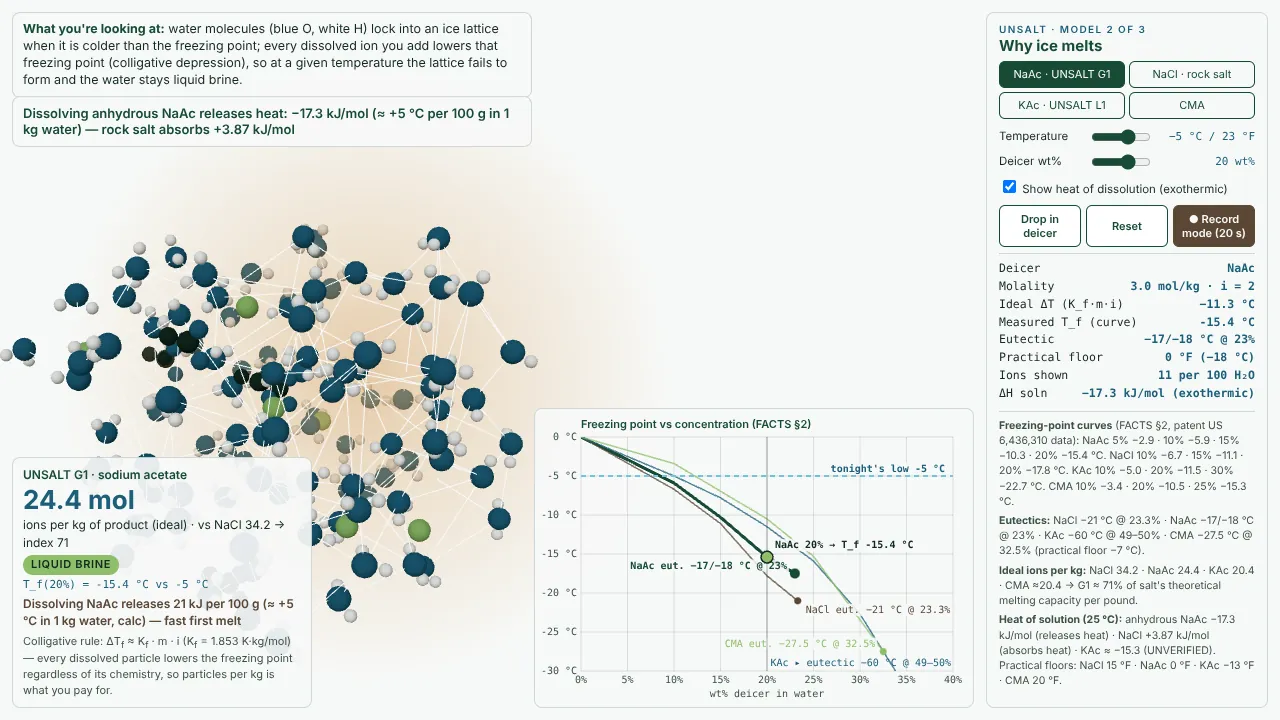
Animated model of an ice lattice of 256 water molecules. Pure water at −5 °C locks into a rigid lattice. Adding 10 wt% sodium acetate lowers the freezing point to −5.9 °C, so the lattice around the dissolved ions breaks into liquid brine. In a cold snap to −14 °C ice returns at 10 wt%; at 20 wt% the freezing point is −15.4 °C and the water stays liquid. Dissolving anhydrous sodium acetate releases heat (−17.3 kJ/mol); rock salt absorbs heat (+3.87 kJ/mol).
ions / kg: NaAc 24.4 · NaCl 34.2 · KAc 20.4
ΔHsol: NaAc −17.3 kJ/mol (warms) · NaCl +3.87 kJ/mol (cools)
Eutectics: NaAc −17.5 °C @ 23% · NaCl −21 °C @ 23.3% · KAc −60 °C @ 49.5% and CMA −27.5 °C @ 32.5% (off chart)
Every dissolved ion lowers the freezing point; fewer ions per kg means more product per square foot.
| NaCl | 34.2 |
|---|---|
| CaCl2 | 27 |
| MgCl2 | 31.5 |
| NaAc | 24.4 |
| KAc | 20.4 |
| CMA | 20.4 |
| urea | 16.7 |
| Deicer | °F | °C |
|---|---|---|
| Rock salt (NaCl) | 15 | −9 |
| UNSALT G1 (NaAc) | 0* | −18 |
| UNSALT L1 (KAc) | −13 | −25 |
| CMA | 20 | −7 |
| Potassium formate | −25 | −32 |
| Sodium formate | 0 | −18 |
WTI/Clear Roads 2023. *Pending our test T1.
| Surface | NaAc | KAc | Salt/sand |
|---|---|---|---|
| Mild steel | 0.0071 | 0.0025 | 2.5 |
| Galvanized | 0.9 | 1.7 | 0.8 |
~99% less corrosive to mild steel than rock salt; comparable on galvanized. Fay et al. 2008 / Shi et al. 2009.
kg O₂ per kg of product. Chloride: zero oxygen demand, and it never degrades.
Sources: WTI/Clear Roads 2023 (practical floors); Fay et al. 2008 / Shi et al. 2009 (corrosion); patent US 6,436,310 (freezing-point curves).
UNSALT Pre-Storm Liquid (L1), the pro move: ~40% potassium acetate, sprayed before the storm so snow never bonds to the pavement. Airports use the 50% version. Cuts total chemical use 25–40%.
How to use
01
Clear loose snow. Ice melt is for the bonded layer, not for moving snow. Every deicer works better on a thin layer, and you use a fraction of the product.
02
About 1 lb covers a 20-ft driveway or ~10 sidewalk squares. Scatter like you're feeding chickens, not pouring sugar.
≈ 0.3 oz/yd² · 10 g/m²
03
Before the storm, spray UNSALT Pre-Storm Liquid at 0.5 gal per 1,000 ft² (a 20×40 ft driveway ≈ 0.4 gal). Snow doesn't bond; you shovel clean and use far less granular.
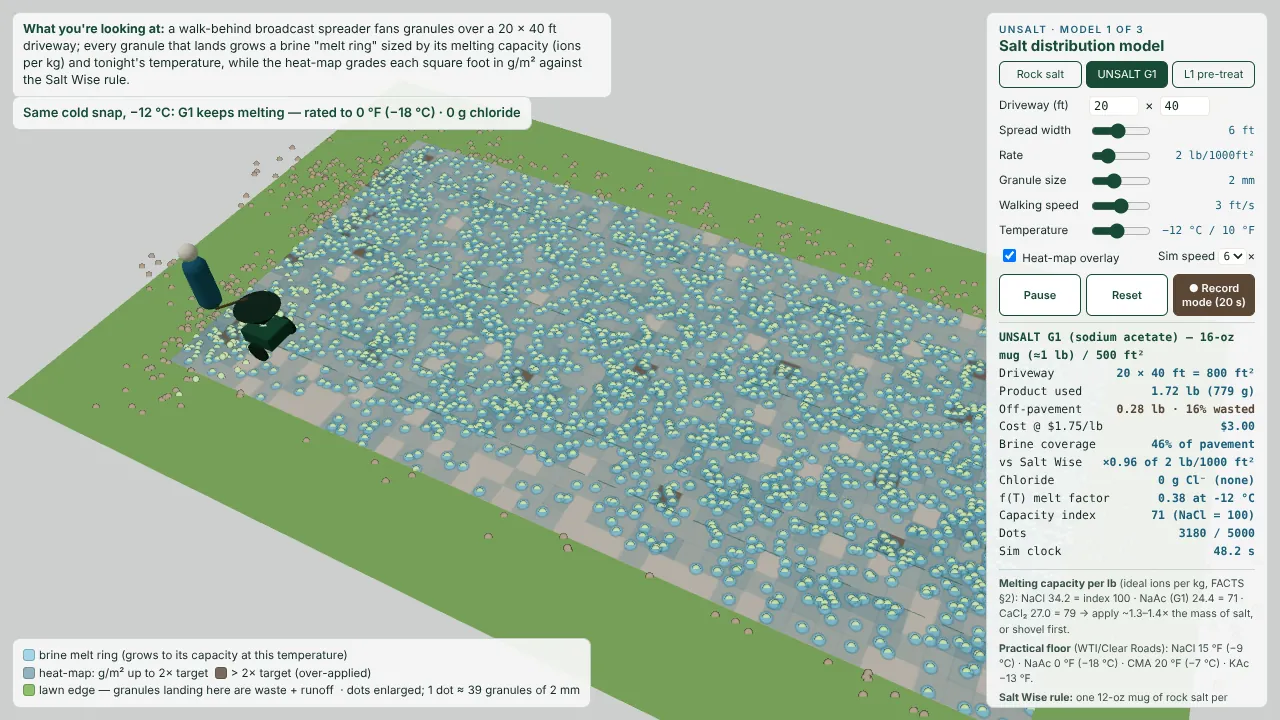
Animated model of a broadcast spreader walking a 20 by 40 foot driveway. Rock salt at −5 °C: each granule grows a ring of brine. In a cold snap to −12 °C, below salt's 15 °F practical floor, the rings refreeze. UNSALT G1 on the same driveway keeps melting through the cold snap (rated to 0 °F*), with 0 g of chloride delivered. Rates: rock salt 1.5 lb and G1 2 lb per 1,000 ft²; shelf prices $0.21/lb and $1.75/lb.
Rock salt absorbs heat as it dissolves (+3.9 kJ/mol) — it chills the ice it is trying to melt. Anhydrous sodium acetate releases heat as it dissolves (−17.3 kJ/mol), so the first minute goes the other way: each granule warms a ring of brine around itself and keeps going. After that, both products work the same way — colligative freezing-point depression — which is why we tell you the honest trade-off: 71% of rock salt's capacity per pound, with none of the chloride.
Melt rings: each granule warms its own puddle (ΔHsol = −17.3 kJ/mol)
What we disclose
Every deicer has a cost. Ours are short-lived and small; rock salt's are permanent. Here they are anyway — the FTC's Green Guides ask for this, and so does Wisconsin.
Acetate biodegrades, which consumes dissolved oxygen: theoretical 0.78 kg O₂ per kg of product. One storm's driveway dose is a few hundred grams of transient oxygen demand in a ditch, versus the same dose of chloride — which is zero oxygen demand and zero degradation, forever. We don't apply L1 as a flood for this reason: anti-icing uses a tenth of the chemical.
Corrosion on zinc/galvanized surfaces is comparable to rock salt (sodium acetate 0.9 vs salt 0.8 MPY). On mild steel it is ~99% lower (0.0071 vs 2.5 MPY). Rinse galvanized railings in spring, as you would with any deicer.
The sodium ion does not break down. A driveway application is far below any soil-sodicity threshold, and sodium acetate is a food additive — but "no chloride" is not "no sodium", and we will never blur that.
No deicer on concrete under one year old — ours included (industry/ACI 332 practice). Acetates do not attack cement paste the way magnesium and calcium chloride do. One caveat for the liquid: concentrated potassium acetate (50%, airfield doses) can accelerate alkali–silica reaction in concrete with reactive aggregate. Our 40% at 0.5 gal/1,000 ft² is ~100× lower exposure than a soaked runway, but: not for daily flooding, not on new concrete.
Potassium is a plant nutrient, but a 2022 MnDOT/UMN study found potassium acetate more toxic to aquatic organisms than expected and slow to biodegrade in cold water. That is exactly why L1 is a pre-storm anti-icer at tiny doses — not a de-icer you pour.
"Works to 0 °F" and "no white residue on floors" are the published behaviour of sodium acetate deicers; our batch-level freezer test (T1) and floor-residue test (T6) run this winter. Until they pass, both claims carry an asterisk — including on this page.
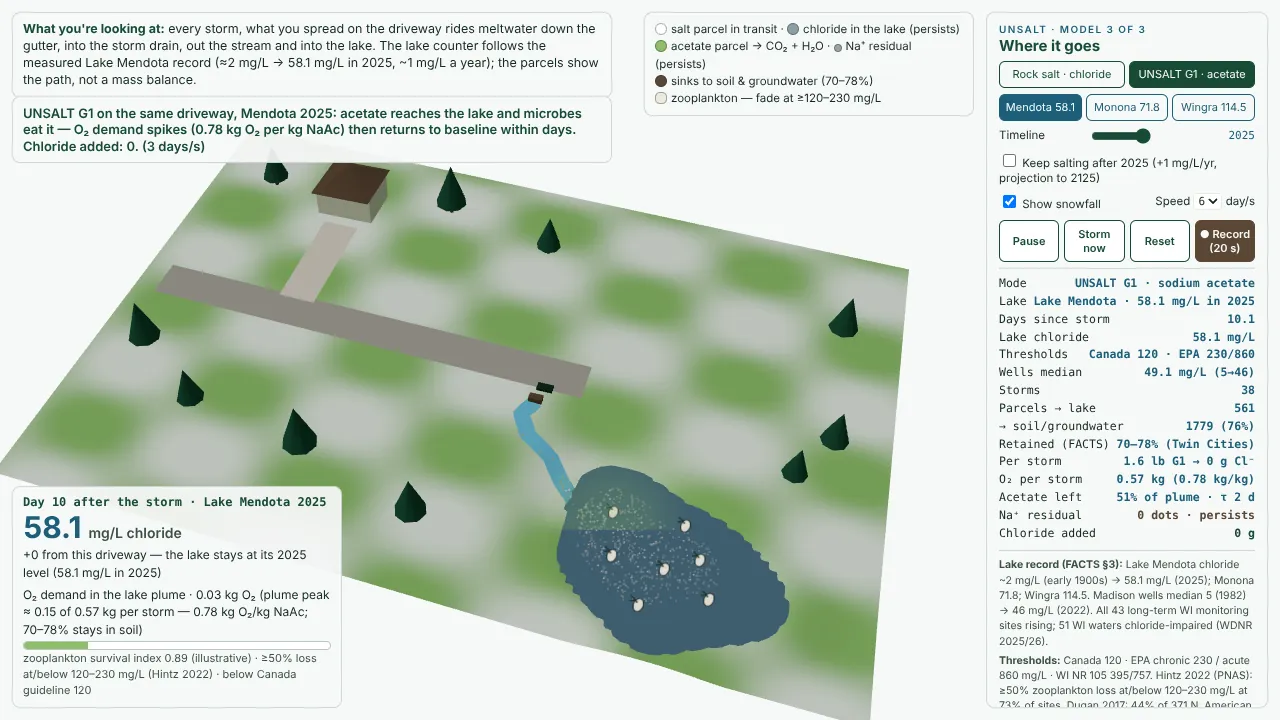
Animated diorama of a driveway draining through a gutter, storm drain and stream into a lake. With rock salt, from 1962 to 2025 the lake's chloride climbs from about 2 mg/L to 58.1 mg/L (Lake Mendota); 74% of each storm's load sinks into the lawn and groundwater and the rest reaches the lake, where chloride never degrades. Projected at +1 mg/L a year, Lake Wingra (114.5 mg/L in 2025) crosses the 120 mg/L Canadian guideline. With UNSALT G1, one storm sends acetate to the lake; it breaks down within days, oxygen demand spikes and returns to baseline, the chloride added is 0 g, and a small sodium residual stays.
Compare
At retail today, "pet-safe" means one of two things: urea (a nitrogen fertilizer that runs off into the same lake) or magnesium chloride (chloride, and the worst of the three for concrete). No chloride-free, urea-free, glycol-free bag exists on the shelf. That is the gap UNSALT fills.
| UNSALT G1 | Rock salt (NaCl) | Urea "pet-safe" blends | MgCl₂ "pet-safe" blends | |
|---|---|---|---|---|
| Active ingredient | Sodium acetate (food additive) | Sodium chloride | Urea (fertilizer), some with propylene glycol | Magnesium chloride |
| Chloride | None | Yes — 61% by weight | None | Yes |
| Practical working temp | 0 °F* | 15 °F | Eutectic −11.5 °C (≈11 °F) | Eutectic −33 °C (practical floor UNVERIFIED) |
| Melting capacity / lb (ideal ions) | 71% of salt | 100% | 49% of salt | 92% of salt |
| First contact | Releases heat (−17.3 kJ/mol) | Absorbs heat (+3.9 kJ/mol) | Absorbs heat (literature; UNVERIFIED) | Releases heat (literature; UNVERIFIED) |
| Mild-steel corrosion (3% soln) | 0.0071 MPY (~99% below salt) | 2.5 MPY | Low | High (chloride) |
| Concrete | No cement-paste attack; not on <1-yr concrete | Highest ingress; drives rebar rust | Mild | Chemically attacks cement paste |
| What runs off | Acetate (biodegrades, 0.78 kg O₂/kg) + sodium | Chloride (never degrades) + sodium | Nitrogen (algae, nitrate in wells) | Chloride + magnesium |
| Retail price / lb (2025–26) | $1.69–1.99 (20 lb bag $34.99) | $0.18–0.24 | $2.00–3.37 | $1.15–2.67 |
Sources: WTI/Clear Roads deicer datasheets 2023; Fay et al. 2008 / Shi et al. 2009 (corrosion, NACE TM0169 PNS method); Sutter 2008 (concrete); 2025–26 retail price survey (Safe Paw, Morton Safe-T-Pet, Safe Step Sure Paws, Green Gobbler). *Pending test T1. Full bibliography in the UNSALT white papers.

For schools, offices & storefronts
The white haze on every January hallway floor is chloride crust. Sodium acetate leaves no chloride behind. (Whether it leaves any visible residue is our floor test T6 this winter — we'll publish the photos either way.)
Pre-order / waitlist
No payment now. We'll email when bags are ready for pickup or local delivery.
FAQ

The Great Lakes are the largest body of unsalted water on Earth. Every winter the roads around them get 16–20 million tons of salt, and every ton stays. One driveway at a time is how it got salted. It's how it gets unsalted, too.
